
When Jesus Delays: What the Story of Lazarus Reveals

Why should you care about a story written two thousand years ago about a man named Lazarus? Because whether we like it or not, every one of us lives with the same quiet reality in the background. Death.

Most of the time, we don’t think about it. We stay busy, make plans, and assume life will continue unfolding in predictable ways. But every so often, something interrupts that illusion. A phone call, a headline, a loss that feels too close. And we’re reminded how fragile everything really is. And when that happens, questions surface that are difficult to ignore. Why does death feel so wrong? Why does it hit so deeply, even when we know it’s inevitable? And if God exists, why doesn’t He step in?
John 11 brings us into one of the most well-known stories in the Bible, the raising of Lazarus. But when you slow down and sit with it, the story is not just impressive. It’s unsettling. Jesus hears that His close friend Lazarus is sick. This isn’t a distant acquaintance. This is someone He loves. The expectation feels obvious. He will go immediately and heal him. But instead, the text tells us that Jesus stays where He is for two more days.
That delay changes everything. It means that while Jesus waits, Mary and Martha are watching their brother get worse. They are hoping, praying, and likely wondering why help hasn’t come. Two days doesn’t sound like much until you’re the one living inside of it. By the time Jesus finally arrives, Lazarus has been dead for four days. This is no longer a situation that can be reversed. It feels final in the way that only death can feel final.
And so the question emerges, both in the text and in our own lives. if Jesus had the power to heal, why didn’t He prevent this?
That question has never really gone away. It shows up in hospital rooms, at funerals, and in the quiet spaces where life doesn’t unfold the way we hoped it would. Most of us, in one way or another, have encountered its weight. Sometimes it’s deeply personal.
The loss of someone who mattered to you in a way that words can’t fully capture. Other times it’s more distant but still unsettling. I remember hearing about Kobe Bryant’s death and feeling a kind of disbelief. For many of us, he seemed larger than life, almost immune to the fragility that defines the rest of us. And yet, even he wasn’t.
Death has a way of leveling everything. It doesn’t matter how successful you are, how young you are, or how much you’ve planned ahead. When it comes, it almost always feels like it came too soon. In response, we try to cope in different ways.
Some attempt to outrun it by maximizing life, filling every moment with experience and activity. Others try to control it, investing in health, longevity, and the hope that we might delay the inevitable long enough to feel secure. But beneath all of it is the same quiet acknowledgment. We know we cannot ultimately win.
This is what makes Jesus’ delay in John 11 so difficult to understand. He had the power to prevent Lazarus’ death, and yet He chose not to act immediately. When He finally speaks, He says something that feels almost disorienting, “Lazarus has died, and for your sake I am glad that I was not there, so that you may believe.” At first glance, that can sound cold. It seems to suggest that something more is happening than simply resolving the immediate pain.
At the very least, the story invites us to hold onto two realities at the same time. First, hardship is not evidence of God’s absence. Second, there are moments when God is doing something deeper than we can see in the moment, even when it doesn’t align with what we would have chosen. Still, that raises an uncomfortable question. Does that mean God is distant, orchestrating events from afar?
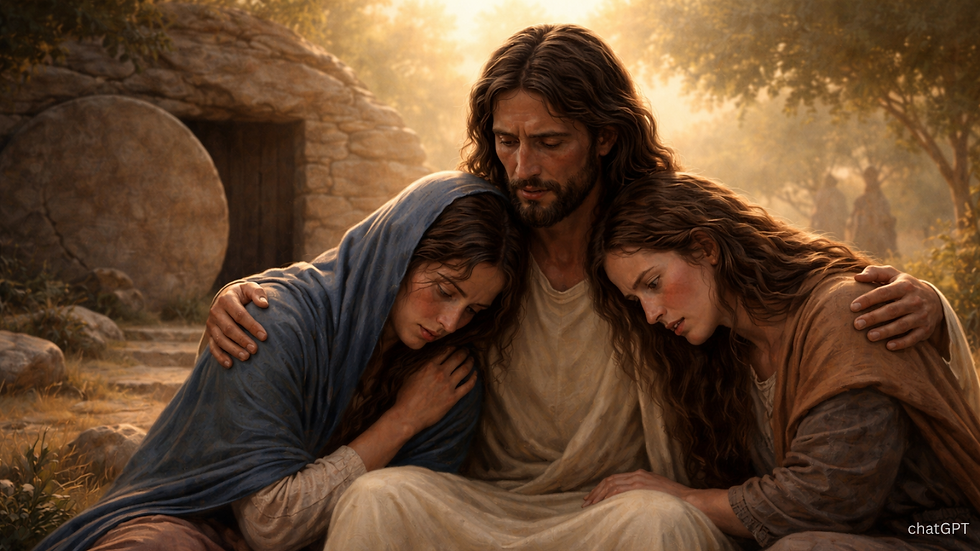
Right in the middle of that tension, we are given one of the shortest and most profound verses in the Bible, “Jesus wept.”
These two words carry more weight than we often realize. Jesus already knows what He is about to do. He knows Lazarus will be raised. He knows this story will not end in tragedy. And yet, when He stands in the presence of grief, He does not rush past it. He enters into it.
He weeps with Mary and Martha.
He allows Himself to feel the weight of their loss. This moment reveals something essential about the nature of God. He is not detached from human suffering, nor is He indifferent to our pain. He is fully present within it. Before He changes the situation, He acknowledges it. Before He resolves the grief, He shares in it.
This reframes how we understand His delay. Whatever God is doing, it is not disconnected from love. Jesus is not a distant observer or a calculating strategist. He is present, compassionate, and deeply moved by the pain of the people He loves.
Then the story shifts.
Jesus approaches the tomb. The grief is still there, the confusion still lingering. The stone is in place, and death still feels final. And in that moment, Jesus says something that would sound almost unbelievable if it weren’t about to be proven, “I am the resurrection and the life.” This is not simply a claim about what He can do, but about who He is.
He asks for the stone to be moved. There is hesitation, understandable resistance, but eventually it is done. Then, in the stillness that follows, Jesus calls out, “Lazarus, come out.” What happens next is almost beyond comprehension. Lazarus walks out of the tomb, still wrapped in burial cloths, but alive.
The shock of that moment must have been overwhelming. Grief collides with disbelief, fear with joy. Death, which had seemed final just moments before, is suddenly undone.
But this miracle is not just about Lazarus. It points beyond itself. It is the final and most significant sign in the Gospel of John, and it sets in motion the events that will lead to Jesus’ own death. From that moment on, opposition against Him becomes decisive. In giving life to Lazarus, Jesus is moving toward His own death.
This reveals a deeper layer to the story. Jesus gives life, knowing it will cost Him everything. And even then, Lazarus’ life is temporary. He will die again one day. This miracle is not the final answer to death, but a sign pointing to something greater.
When Jesus says, “Whoever believes in me, though he die, yet shall he live,” He is speaking of more than physical life. He is pointing to a life that death cannot ultimately overcome. The raising of Lazarus is a preview of that reality, a glimpse of the greater resurrection to come.
Without God, death is simply the end. It is the natural conclusion of life, the closing of the story. And yet, that is not how we experience it. We grieve deeply, we resist instinctively, and we sense that something about it is not right. The Christian story affirms that instinct. It tells us that death is not merely natural. It is an enemy. And more than that, it tells us that this enemy has been defeated.
This is why Christian hope feels different. It does not deny grief or pretend that loss does not hurt. Jesus Himself wept, and so we are free to do the same. But it also refuses to accept death as the final word. For those who trust in Jesus, death is not the end of the story. It is not meaningless, and it is not permanent.
At the center of this passage, Jesus asks Martha a question that extends beyond the moment and into our own lives, “Do you believe this?” It is not simply a theological question, but a deeply personal one. Do we believe that death does not have the final say? Do we believe that Jesus is who He claims to be? And if we do, what would it look like to actually live as if that were true?
Because if this is true, then it reshapes more than just how we think about death. It reshapes how we live. It changes what we value, what we fear, and what we hold onto. And it forces us to consider a deeper question. Not just what happens when we die, but what we are living for while we are still here.


Comments